Universiteto g. 5
01122 Vilnius Lithuania
Lituanie
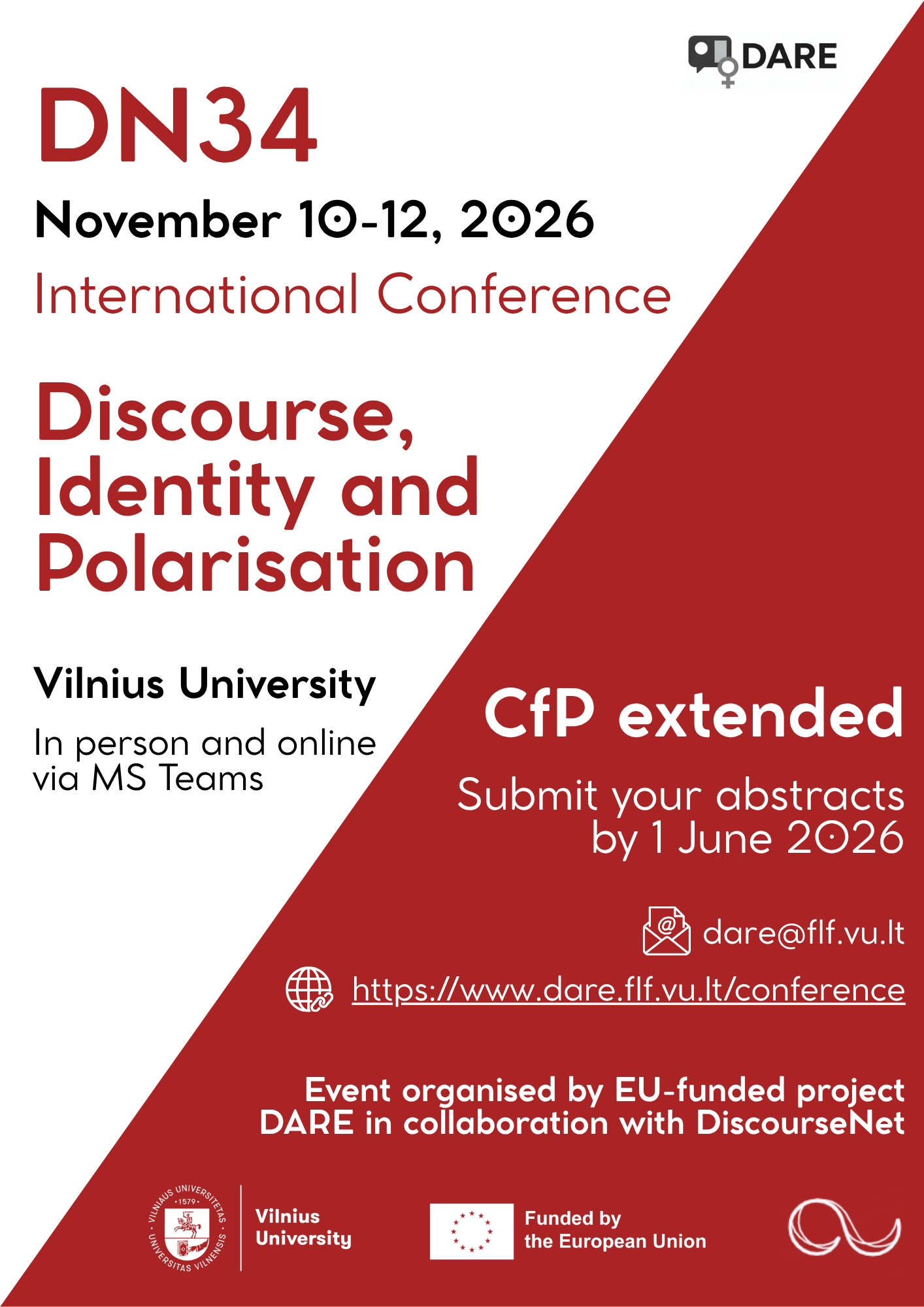
The DN34 International Conference on Discourse, Identity and Polarisation will be held 10–12 November 2026 at Vilnius University and online. The call for papers and panel proposals is open until 15 May 2026. This hybrid conference provides an interdisciplinary space for examining how individual and group identities are discursively constructed in today’s increasingly polarised societies, and how discourse both reflects and shapes emerging social divisions. Although identity construction has long been central to discourse analysis, this conference places the interrelation between identity, subjectivity and polarisation at the forefront. In a context of political, cultural and epistemic fragmentation, identity is not only performed but also continually renegotiated through discourse. We therefore invite contributions that explore how discursive practices contribute to the reproduction, negotiation or mitigation of social divides, and how identities emerge through processes of positioning, contestation and boundary-making.
Across global public spheres, ongoing debates around issues such as migration, climate change, social security, AI governance and geopolitical tensions have become sharply polarised. These debates not only construct conflict but also actively participate in defining hegemonic and counter-hegemonic projects. Following Mouffe (1999, 2005, 2013), antagonism can be understood as a discursively constructed relation that shapes subjectivities and organises the social through competing visions of the common good. From a Foucauldian (1966/2005) perspective, these struggles are embedded within broader epistemes of historically specific formations of knowledge that delimit what can be said, thought and legitimised. Polarisation is therefore not merely an empirical phenomenon but part of a power/knowledge configuration that governs how social problems are framed, which subjects are authorised to speak, and which interpretations gain dominance. DN34 thus aims to problematise the very notion of polarisation, asking how it is defined, invoked and contested across disciplines, and what consequences these discourses have for identity, hegemony and social cohesion. The rise of right-wing populisms has intensified these dynamics, recontextualising polarisation as a form of antagonism and further deepening social divisions (Krzyżanowski, 2020; Mudde, 2022; Porto & Romano, 2025).
Building on this understanding of polarisation as a discursive process, research on discourse, identity and subjectivity further highlights how linguistic choices shape the ways individuals position themselves and others within specific socio-cultural contexts (Bös et al., 2018; Huang & Holmgreen, 2020; Morales-López & Floyd, 2017). These contexts, in turn, influence the social production of meaning (Angermuller, 2014) and interpretation of discourse (Frank, 2008), making discourse and context mutually constitutive. This dynamic interaction reveals how agency, legitimacy, power and polarisation materialise in communicative practices (Bamberg et al., 2011; Bucholtz & Hall, 2010). Polarisation, often realised as the discursive opposition between “Us” and “Them” (Van Leeuwen, 2008; Koller, 2012), thus provides a productive lens for examining how social groups construct themselves and others (Van Dijk, 1998; Wodak, 2011, 2021) and connects directly back to the antagonistic configurations described above.
In this context, the conference invites scholars at all career stages from across the transdisciplinary field of Critical Discourse Studies to explore how social divisions, subjectivities and identities are discursively shaped, contested and transformed. Contributions may engage with, but are not limited to, the following themes:
- Discourse and identity in times of polarisation: How are individual and group identities discursively constructed in contexts of social division or conflict?
- Identity, polarisation and socio-cultural situatedness: How do specific socio-cultural settings shape the discursive construction of identity and polarisation?
- Discursive strategies of identity and polarisation: Which linguistic or multimodal strategies enhance, negotiate or challenge polarisation?
- Affect, identity and polarisation: What emotional registers are salient in discourses of identity and polarisation? How do affect and emotion shape subjectivities and social divisions?
- Topical constructions of identity: Which issues or policy areas become focal points for the discursive construction of identities and divisions?
- Genres, media and polarisation: How do different discourse genres shape identity and polarisation?
- Nationalism, populism and identity politics: How do populist and identity-based discourses contribute to polarisation, hegemony and counter-hegemony?
- Discourse, identity and intersectionality: How do dimensions such as gender, race, ethnicity, nationality, sexuality and ideology interact in the discursive construction of identity in polarised worlds?
- Digital identities and online communities: How are identities constructed in digital spaces, and what role do online communities play in spreading or contesting polarisation?
- Historical and diachronic perspectives: What can historical developments teach us about the evolving relationships between discourse, identity and polarisation?
- Theoretical and methodological challenges: Which theoretical frameworks and methods are most suitable for analysing discourse, identity and polarisation?
This conference aligns with the EU-funded DARE project, which supports the event and investigates how polarisation and identities surrounding the abortion debate are constructed in European mainstream news media.
Submission guidelines
Abstracts should be 250 – 400 words (including references) and anonymous. Please specify the tentative presentation mode (online or offline). It would be possible to switch once the choice has been made
- Use APA 7th edition style for references and include five keywords
- The language of the conference is English
- Full panel proposals: Panels with three to five presentations with a panel chair are welcome. Please include the abstract of the panel and paper abstracts
- Presentations should be 20 minutes long and will be followed by a 10-minute discussion
- Submit your abstracts via the conference submission platform: https://www.dare.flf.vu.lt/registration
Important dates
- Abstract submission deadline: May 15, 2026
- Notification of acceptance: June 30, 2026
- Registration deadline: September 1, 2026
- Conference dates: November 10–12, 2026
Fees & registration
Participants are required to hold an active DiscourseNet membership (€60 for 2 years). No registration fee apart from DN membership is required. You can obtain a valid DN membership via this link. More information can be found here.
The cost of coffee breaks and opening reception will be covered by the organisation.
Venue
The conference will be a hybrid event, held in person at Vilnius University (Universiteto g. 5, 01122 Vilnius, Lithuania) and online through MS Teams.
Committees and organisation
The conference is hosted by Vilnius University, Lithuania, in collaboration with DiscourseNet – International Association for Discourse Studies and the DARE Horizon Europe project, funded by the European Commission.
- Local Organising Committee (VU): chair: Silvia Peterssen, co-chair: Liudmila Arcimavičienė
- Organising team: Jurga Cibulskienė, Lina Inčiuraitė-Noreikienė, Lina Marčiulionytė, Virginija Masiulionytė, Irena Snukiškienė
- International Organising Committee: Thomas Jacobs and Benno Herzog
- Scientific Committee: Isabel Alonso (Autonomous University of Madrid), Ieva Bisigirskaitė (VU), Aurora Fragonara (University of Picardy-Jules Verne), Michael Kranert (University of Southampton), Jens Maesse (University of Giessen), Magdalena Nowicka-Franczak (University of Lodz), Leandro Paolicchi (Mar del Plata University), Dolores Porto (University of Alcalá), Manuela Romano (Autonomous University of Madrid), Anna Ruskan (VU), Inesa Šeškauskienė (VU), Jolanta Šinkūnienė (VU), Audronė Šolienė (VU), Orlagh Woods (VU)
Keynotes
The following keynote speakers are confirmed:
- Ruth Breeze (University of Navarra)
- Veronika Koller (Lancaster University)
- Augusto Soares da Silva (Catholic University of Portugal)
- Jan Zienkowski (Université Libre de Bruxelles)
Publication opportunities
Selected contributions may be considered for publication in an edited volume, to be tentatively published in the DiscourseNet Work-in-Progress Series, the Palgrave Book Series.
Contact
For questions, please contact the organising team at: www.dare@flf.vu.lt
References
Angermuller, J. (2014). Poststructuralist discourse analysis: subjectivity in enunciative pragmatics. Springer.
Bamberg, M., De Fina, A., & Schiffrin, D. (2011). Discourse and Identity Construction. In S. J. Schwartz, K. Luyckx, & V. L. Vignoles (Eds.), Handbook of Identity Theory and Research (pp. 177–199). Springer Science+Business Media. https://doi.org/10.1007/978-1-4419-7988-9_8
Bös, B., Kleinke, S., Mollin, S., & Hernández, N. (Eds.). (2018). The Discursive Construction of Identities On-and Offline: Personal - group - collective. John Benjamins. http://benjamins.com/catalog/dapsac
Bucholtz, M., & Hall, K. (2010). Locating Identity in Language. In C. Llamas & D. Watt (Eds.), Language and Identities (pp. 18–28). Edinburgh University Press. https://doi.org/10.1515/9780748635788-006
De Fina, A., Schiffrin, D., & Bamberg, M. (2006). Introduction. In A. De Fina, D. Schiffrin, & M. Bamberg (Eds.), Discourse and Identity (pp. 1–24). Cambridge University Press. https://doi.org/10.1017/CBO9780511584459.001
Filardo-Llamas, L., Morales-López, E., & Floyd, A. (Eds.). (2021). Discursive Approaches to Socio-political Polarization and Conflict (preprint). Routledge. https://doi.org/10.4324/9781003094005
Foucault, M. (1966/2005). The order of things. Routledge.
Frank, R. M. (2008). Introduction: Sociocultural situatedness. In R. M. Frank, R. Dirven, T. Ziemke, & E. Bernárdez (Eds.), Body, Language, and Mind: Sociocultural Situatedness (pp. 1–18). De Gruyter Mouton.
Koller, V. (2012). How to Analyse Collective Identity in Discourse – Textual and Contextual Parameters. Critical Approaches to Discourse Analysis Across Disciplines, 5(2), 19–38.
Krzyżanowski, M. (2020). Normalization and the discursive construction of “new” norms and “new” normality: discourse in the paradoxes of populism and neoliberalism. Social Semiotics, 30(4), 431–448. https://doi.org/10.1080/10350330.2020.1766193
Morales-López, E., & Floyd, A. (2017). Developing New Identities in Social Conflicts: Constructivist Perspectives. John Benjamins Publishing Company. http://ebookcentral.proquest.com/lib/viluniv-ebooks/detail.action?docID=4983485
Mouffe, C. (1999). Deliberative democracy or agonistic pluralism? Social Research 66(3): 745–758.
Mouffe, C. (2005). On the Political. London: Routledge.
Mouffe, C. (2013). Agonistics: Thinking the World Politically. London; New York: Verso.
Mudde, C. (2022). The far-right threat to liberal democracy in Europe, explained. Vox. https://www.vox.com/world/23516807/europe-right-wing-parties-orban-meloni
Porto, M. D., & Romano, M. (2025). Polarisation: the new superword. Meanings and current uses in English and Spanish. Journal of Corpora and Discourse Studies (8).
Roskamm, N. (2015). On the other side of “agonism”: “The enemy,” the “outside,” and the role of antagonism. Planning Theory, 14(4), 384-403.
Van Dijk, T. A. (1998). Ideology: A multidisciplinary approach. SAGE. https://doi.org/10.4135/9781446217856
Van Leeuwen, T. (2008). Discourse and Practice: New Tools for Critical Discourse Analysis. Oxford University Press.
Wodak, R. (2011). “Us” and “Them”: Inclusion and Exclusion – Discrimination via Discourse. In G. Delanty, R. Wodak, & P. Jones (Eds.), Identity, Belonging and Migration (pp. 54–77). Liverpool University Press. https://doi.org/10.5949/UPO9781846314537.004
Wodak, R. (2021). The Politics of Fear: The Shameless Normalization of Far-Right Discourse (2nd ed.). SAGE.
• Organising team: Jurga Cibulskienė, Lina Inčiuraitė-Noreikienė, Lina Marčiulionytė, Virginija Masiulionytė, Irena Snukiškienė
• International Organising Committee: Thomas Jacobs and Benno Herzog
• Scientific Committee: Isabel Alonso (Autonomous University of Madrid), Ieva Bisigirskaitė (VU), Aurora Fragonara (University of Picardy-Jules Verne), Michael Kranert (University of Southampton), Jens Maesse (University of Giessen), Magdalena Nowicka-Franczak (University of Lodz), Leandro Paolicchi (Mar del Plata University), Dolores Porto (University of Alcalá), Manuela Romano (Autonomous University of Madrid), Anna Ruskan (VU), Inesa Šeškauskienė (VU), Jolanta Šinkūnienė (VU), Audronė Šolienė (VU), Orlagh Woods (VU)