Pomorska 171/173
University of Lodz, Faculty of Philology, Department of Pragmatics
90-236 Lodz
Polonia
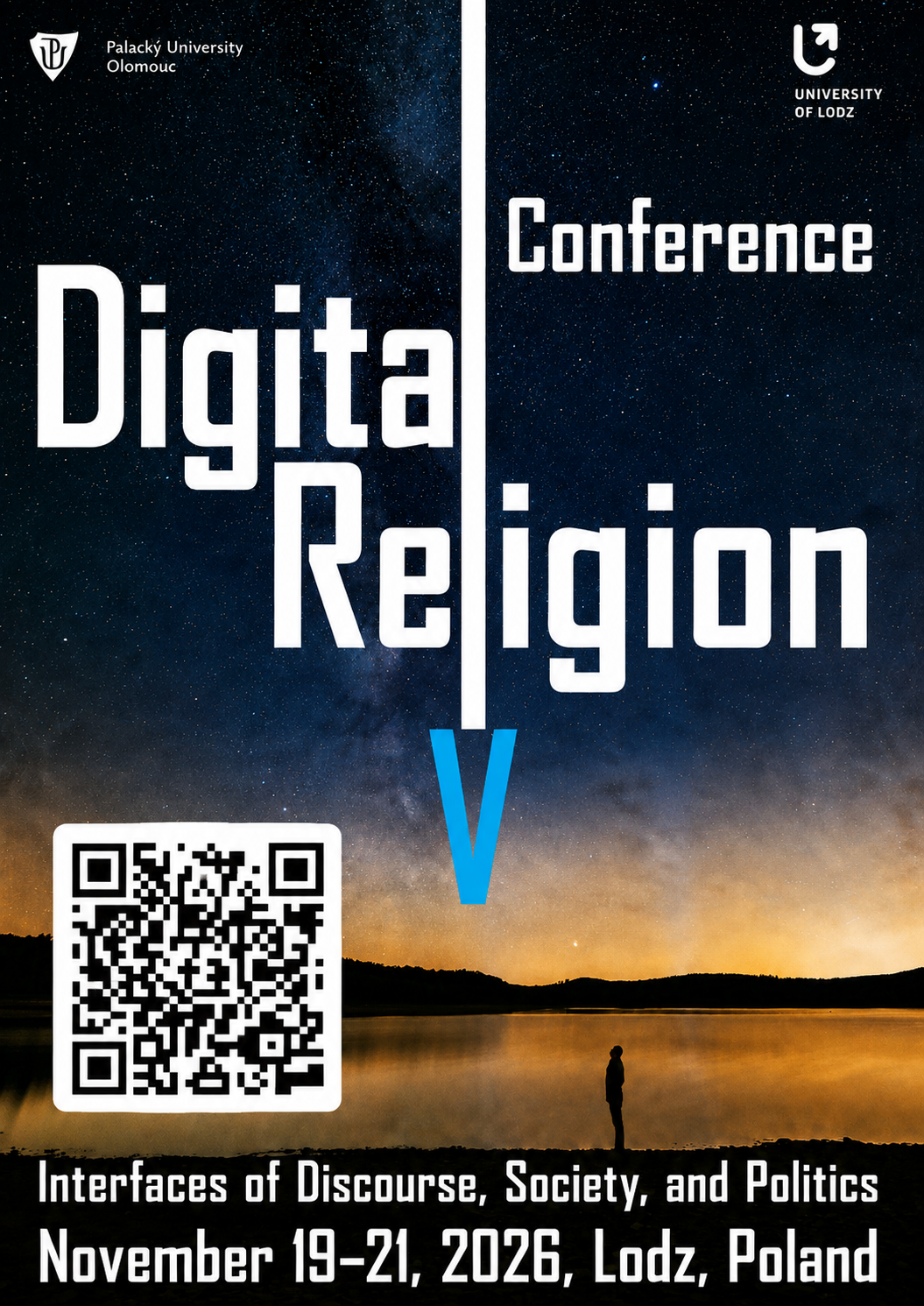
Positioned within contemporary struggles over public meaning, social affiliation and political legitimacy, digital religion is articulated through mediated practices in which claims about faith, community, authority and truth become resources for negotiating belonging, morality, identity and power.
Digital Religion V invites papers that examine these practices at the interfaces of discourse, society and politics, with a focus on digital religious discourse both as product and as practice: as a textual and multimodal form, and as situated action involving the production, distribution, and consumption of religious meanings across platforms, publics and institutional contexts.
The interfaces are approached as sites of contact and tension, with religious doctrine informing everyday moral judgement, ritual participation intersecting with activism, institutional authority being negotiated alongside influencer charisma, and private spirituality assuming sociopolitical significance. Central to these processes are conceptualization, representation, recontextualization and affect: religious meanings are made cognitively accessible, salient, and invested with the emotional force. Digital affordances, in turn, enable their circulation across genres, platforms and publics, attaching them to causes and conflicts and intensifying the interplay between religious expression, social affiliation and political positioning.
We invite papers addressing, but not limited to, the following questions and areas:
• How does digital religious discourse shape public debates, legitimise authority or mark the limits of belonging?
• How do social and political conflicts become legible through religion in platformed public communicative practice?
• Under what conditions do digital religious practices sustain care, solidarity, memory and participation, or produce antagonism, exclusion and radicalisation?
• What happens when politics borrows religious repertoires, when religious actors adopt platform tactics, and when platforms order religious visibility?
• How are institutional religion, lived religion, spirituality, atheism and anti-religious discourse brought into contact in digital environments?
• How are religious authority, expertise, authenticity, charisma and credibility established, challenged or displaced under conditions of platformed visibility?
• How do religious symbols, narratives, values and moral vocabularies enter nationalism, populism, conspiracy cultures, extremism and culture-war discourse?
• How do metaphors organise the affective and moral intelligibility of digital religious discourse, shaping how publics recognise threat, victimhood, duty, crisis, hope or belonging?
• How are religious identities politicised, and how are social or political conflicts religionised, across digital platforms?
• How do digital religious discourses construct publics, counter-publics, minorities, moral communities, dissent and exclusion?
• How are gender, sexuality, race, ethnicity, migration, diaspora, class, generation and disability articulated through religious and anti-religious discourse online?
• How does digital religious communication respond to war, displacement, ecological crisis, violence, inequality, insecurity and social change?
• How does affect shape the public force of digital religion, from fear, hope and compassion to resentment, moral outrage, grief and collective grievance?
• How do digital affordances, algorithms, metrics, moderation, recommendation systems and visibility regimes condition religious discourse and participation?
We welcome theoretical, methodological and empirical papers from media and communication studies, discourse studies, religious studies, theology, sociology, anthropology, political science, linguistics, cultural studies, digital humanities and related fields. Contributions may focus on particular platforms, communities, traditions, controversies or media genres, as well as on comparative, transnational or historical perspectives.
University of Lodz
Poland
in collaboration with
Department of Communication
Palacky University Olomouc
Czech Republic
and
Center for the Study of the Digital Public Sphere
University of Silesia in Katowice
Poland