Große Scharrnstr. 59
15230 Frankfurt (Oder)
Germany
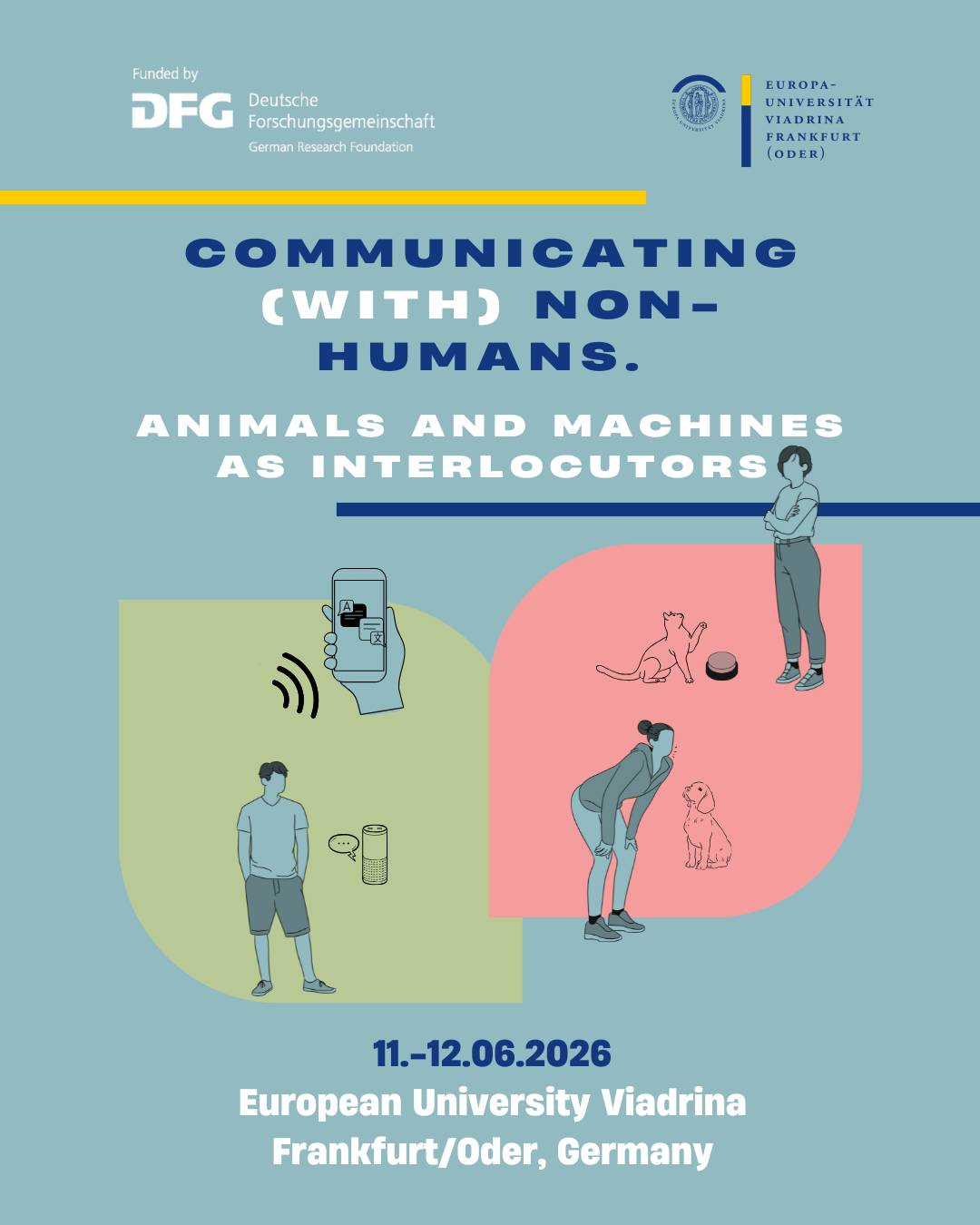
Communicating (with) Non-Humans. Animals and Machines as Interlocutors
European University Viadrina Frankfurt (Oder), Germany
Date: June 11th/12th 2026
From voice assistants and generative AI to the evolving relationships between humans and their animal companions, language-based communication with non-humans is becoming an increasingly common feature of the everyday. In response, we are seeing a surge in research from linguistics to philosophy to the social sciences, investigating the meanings, quandaries, and realities of this new communicative terrain. This conference aims to build a bridge between the predominantly distinct fields of human–animal and human–machine communication in order to jointly investigate the similarities and differences in our communicative practices when languaging with non-human others.
In human–animal communication, the so-called ‘animal turn’ in the humanities and social sciences has led to a changing understanding of animal actors in social interaction. No longer are they treated as mere objects of communication (see e.g. Bergmann 1988), or addressees (Huneke 2004); animals are instead interactional partners who must be taken seriously (Peltola & Simonen 2024; Szczepek Reed & Lundesjö Kvart 2025). While this turn has materialised unevenly—with primary attention paid to dogs (e.g. Mondémé 2023) and cats (e.g. Harjunpää & Szczepek Reed 2025)—it has ramifications for the study and consideration of all animals (e.g. Cornips 2024).
Rapid changes are also being seen in the field of human–machine interaction, propelled by advances in the linguistic and communicative capabilities of new technologies. Examinations have been launched into the theoretical potential of social robots as everyday companions for humans (Hepp 2020; Pitsch 2023), the specific communication strategies in interaction with voice user interfaces (Cohn et al. 2021; Reineke & Helmer 2024; Beneteau et al. 2019), social and multilingual practices in these interactions (Leblebici 2024; Hector 2023; Zhu et al. 2024; Nikghalb & Cheng 2025), and evolving attitudes towards ‘speaking machines’ such as Alexa or ChatGPT (Dynel 2023; Lehner 2023). Newer LLM-based technology, under the umbrella term of generative AI, raises questions about agency (Heaton et al. 2025), authority (Ferrario, Facchini & Termine 2024; Gefen & Arinze 2023), and the boundaries of language and conversation (Handman 2023; Hill, Randolph Ford & Farreras 2015). The interactional analysis of these technologies is, however, still in its infancy (Dai, Zhu & Chen 2025; Pütz & Esposito 2024).
Many aspects of human–machine and human–animal communication still require investigation, particularly when it comes to the empirical study of mundane everyday interaction, multimodality, and the changing forms of engagement with ever-evolving language technologies. We invite papers presenting original research (both empirical and theoretical) on the interaction and communication between human and non-human interlocutors, the role of non-humans as social actors, and changing conceptualisations of language and communication in the context of “talking” machines and animals. Potential areas of interest concern (but are not limited to):
- Language attitudes and ideologies regarding non-human interlocutors and their linguistic capacity
- Interaction with (companion) animals and communicative machines in domestic, public or therapeutic environments
- The use of and interaction with voice user interfaces and smart technologies such as Amazon’s Alexa and Google home
- Animal directed speech and “Animal Semiotic Code” (Mondémé 2018)
- The use of and interaction with generative AI (e.g. ChatGPT, Gemini)
- Embodiment and multimodality in interaction with non-humans
- Technologically mediated interactions between humans and animals (e.g. Talking Buttons)
- The construction and representation of human–non-human interaction in social media
- Strategies of addressing and naming non-human others
- Linguistic similarities and differences between humans, animals, and machines
- Posthumanist approaches to communicating (with) non-humans
- Critical investigations of power, in-/exclusion and inequality in human–non-human interaction
- Methodological challenges and strategies for collecting natural interactional data between humans and non-humans
The conference is organized by the DFG-funded Emmy Noether research group “Posthumanist linguistics? Communicative practices between humans, animals, and machines” (team: Miriam Lind (PI), Marlén Jacobshagen, Hannah Sawall). It will take place over two days on June 11th/12th at European University Viadrina in Frankfurt/Oder, Germany. We invite abstract submissions (max. 300 words excluding references) for papers (20 minutes presentation + 10 minutes discussion) to be sent to mtm@europa-uni.de as a .pdf or .docx file. The deadline for submissions is January 31st 2026. Notifications of acceptances will be sent out by February 28th 2026. Feel free to contact us with any questions and to inform us about potential support and accessibility needs.