Belgaid, Bir El Djir, 31023 Oran, Algeria
31023 Oran
Argelia
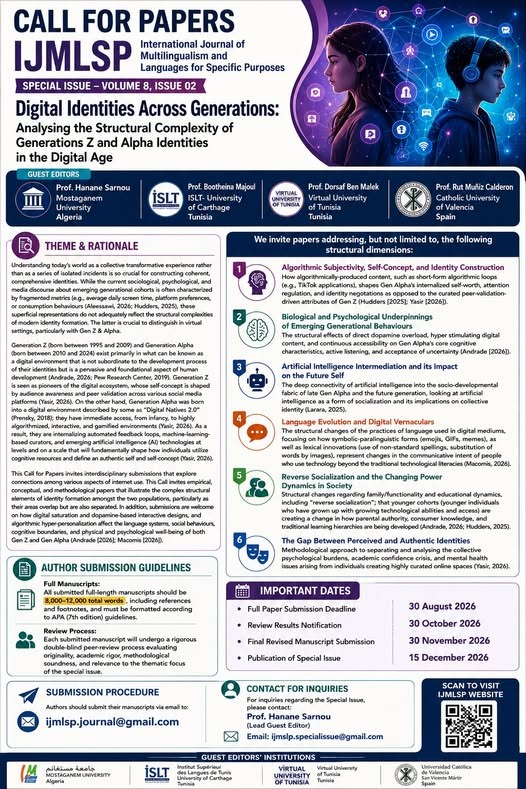
Call for Papers | IJMLSP Volume 08 – Issue 02
Digital Identities Across Generations:
Analysing the Structural Complexity of Generations Z and Alpha Identities in the Digital Age
International Journal of Multilingualism and Languages for Specific Purposes (IJMLSP)
Editor-In-CHIEF

Prof Ouahmiche Ghania
University of Oran 2 Mohamed Ben Ahmed – Algeria
Guest Editors
Prof Hanane Sarnou
Mostaganem University - Algeria

Prof Bootheina Majoul
ISLT - University of Carthage - Tunisia

Prof Dorsaf Ben Malek
Virtual University of Tunisia - Tunisia

Prof Rut Muňiz Calderon
Catholic University of Valencia - Spain
Theme & Rationale
Understanding today’s world as a collective, transformative experience rather than as a series of isolated incidents is crucial to constructing coherent, comprehensive identities. While the current sociological, psychological, and media discourse about emerging generational cohorts is often characterized by fragmented metrics (e.g., average daily screen time, platform preferences, or consumption behaviours (Aleessawi, 2026; Hudders, 2025), these superficial representations do not adequately reflect the structural complexities of modern identity formation. The latter is crucial to distinguish in virtual settings, particularly with Gen Z & Alpha.
Generation Z (born between 1995 and 2009) and Generation Alpha (born between 2010 and 2024) exist primarily in what can be known as a digital environment that is not subordinate to the development process of their identities but is a pervasive and foundational aspect of human development (Andrade, 2026; Pew Research Center, 2019). Generation Z is seen as pioneers of the digital ecosystem, whose self-concept is shaped by audience awareness and peer validation across various social media platforms (Yasir, 2026).
On the other hand, Generation Alpha was born into a digital environment described by some as “Digital Natives 2.0” (Prensky, 2018); they have immediate access, from infancy, to highly algorithmized, interactive, and gamified environments (Yasir, 2026). As a result, they are internalizing automated feedback loops, machine-learning-based curators, and emerging artificial intelligence (AI) technologies at levels and on scales that will fundamentally shape how individuals utilize cognitive resources and define their authentic selves and self-concepts (Yasir, 2026).
This Call for Papers invites interdisciplinary submissions that explore connections among various aspects of internet use. We invite empirical, conceptual, and methodological papers that illustrate the complex structural elements of identity formation amongst the two populations, particularly where their areas overlap yet remain distinct. In addition, submissions are welcome on how digital saturation, dopamine-based interactive designs, and algorithmic hyper-personalization affect the language systems, social behaviours, cognitive boundaries, and physical and psychological well-being of both Gen Z and Gen Alpha (Andrade; Macomis).
Structural Dimensions Addressed
1. Algorithmic Subjectivity, Self-Concept & Identity ConstructionHow algorithmically-produced content, such as short-form algorithmic loops (e.g., TikTok), shapes Gen Alpha’s internalized self-worth, attention regulation, and identity negotiations as opposed to the curated peer-validation-driven attributes of Gen Z (Hudders; Yasir).
2. Biological & Psychological Underpinnings of Emerging Generational BehavioursThe structural effects of direct dopamine overload, hyperstimulating digital content, and continuous accessibility on Gen Alpha’s core cognitive characteristics, active listening, and acceptance of uncertainty (Andrade).
3. AI Intermediation & Future SelfThe deep connectivity of artificial intelligence into the socio-developmental fabric of late Gen Alpha and the future generation, looking at artificial intelligence as a form of socialization and its implications on collective identity (Larara, 2025).
4. Language Evolution & Digital VernacularsStructural changes of language practices in digital mediums, focusing on how symbolic-paralinguistic forms (emojis, GIFs, memes) and lexical innovations represent shifts in communicative intent beyond traditional literacies (Macomis, 2026).
5. Reverse Socialization & Power DynamicsStructural updates to family and educational dynamics, where younger tech-proficient cohorts trigger a shift in how parental authority, consumer knowledge, and traditional learning hierarchies develop (Andrade, 2026; Hudders, 2025).
6. Perceived vs. Authentic Identities GapMethodological approaches to separating and analysing collective psychological burdens, academic confidence crises, and mental health issues arising from individuals creating highly curated online spaces (Yasir, 2026).
Author Submission Guidelines:
- Full Manuscripts: All submitted full-length manuscripts should be 8,000–12,000 total words, with reference materials and footnotes included.
- Formatting Style: Mandatory adherence to the APA (7th ed. style guide).
- Review Process: Each submitted work will undergo a rigorous double-blind peer-review process considering originality, academic rigor, and structural relationship to the thematic core.
References
- Aleessawi, N. A. K. A., Aissani, R., Rsheidat, J. M. A. M., & Habes, M. (2026). Communication Preferences of Generations X, Y, and Z in Receiving Media Content. Journalism and Media, 7(2), 81. https://www.mdpi.com/2673-5172/7/2/81
- Andrade, B. B., Araújo Pereira, M., & Avena, K. (2026). Dopamine, distraction, and disruption: Perspectives on how technology and Generation Z are reshaping medical education. JMIR Medical Education, 12(1), e80791. https://mededu.jmir.org/2026/1/e80791/citations
- Hudders, L. (2025). Capturing attention: Understanding the dynamics of interactive advertising to engage Generation Alpha. Journal of Interactive Advertising, 25(3), 259–272. https://doi.org/10.1080/15252019.2025.2591720
- Macomis, M. A., Alayon, A. I., Bihasa, J. M., & Pasion, C. K. (2026). Generational Patterns in Digital Linguistic Styles: A Quantitative Study of Millennials, Gen Z, and Gen Alpha. Journal of Gender and Millennium Development Studies, 3(1), 32–51. https://doi.org/10.64420/jgmds.v3i1.515
- Pew Research Center. (2019). Defining generations: Where Millennials end and Generation Z begins. https://www.pewresearch.org/short-reads/2019/01/17/where-millennials-end-and-generation-z-begins/
- Prensky, M. (2018). Digital natives 2.0: Empowering the upcoming generation of learners. Educational Technology Leadership, 41(3), 112–125. https://www.researchgate.net/publication/325039554
- Yasir, W., Kayani, H. W., Ikram, S., Ikram, S., Sajjad, Y., & Naeem, I. (2026). From Scrolling to Self-Concept: A Comparative Study of Digital Identity and Academic Development in Generation Z and Generation Alpha. Research Journal for Social Affairs, 4(3(s1), 33-43. https://doi.org/10.71317/RJSA.004.03(a).0826